


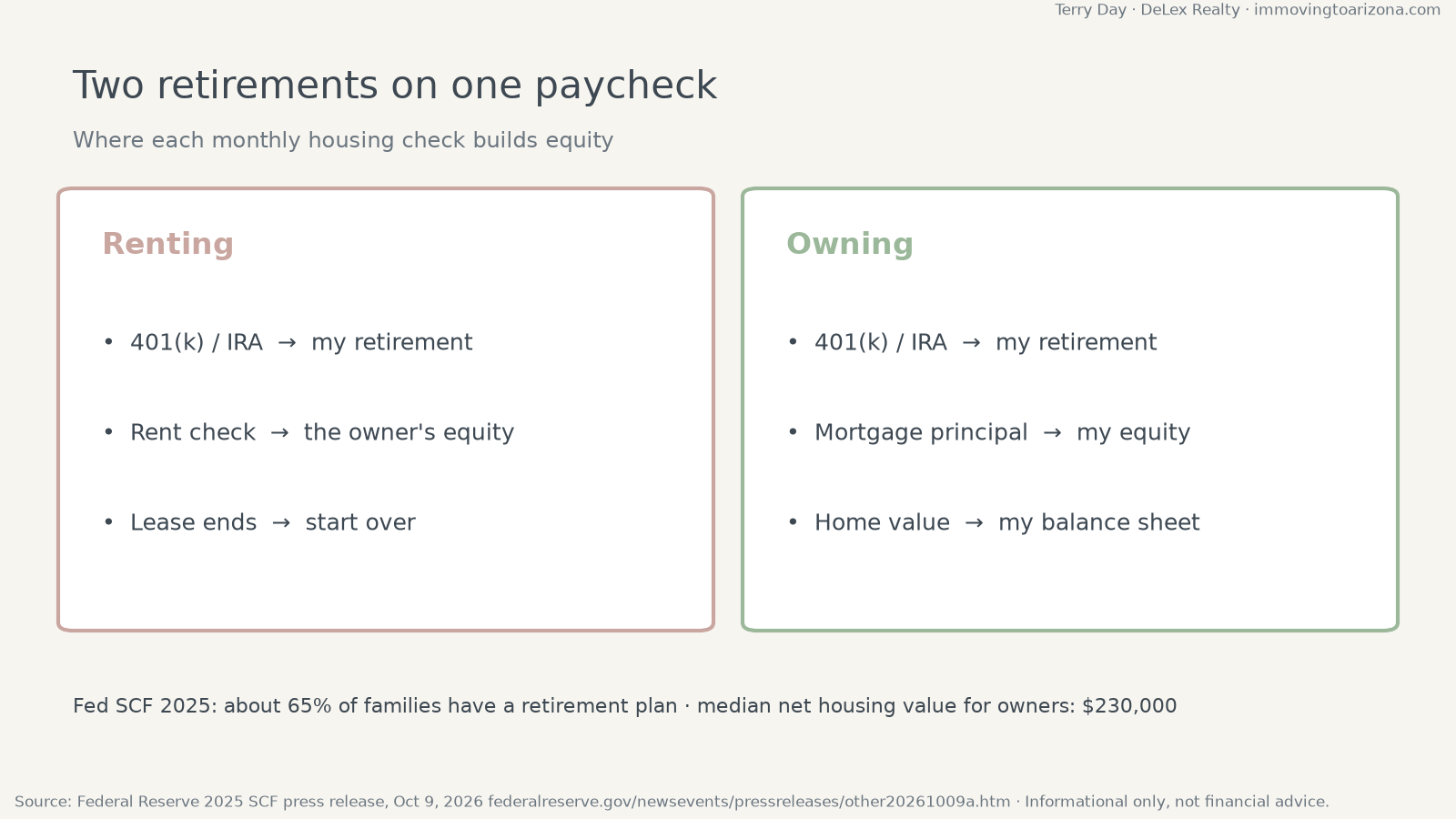
Friday is payday for a lot of people. For many of the renters I talk with, the paycheck splits in a familiar way: a contribution goes into a 401(k), and a rent payment goes to the landlord. I think of that as funding two retirements. One is yours. The other belongs to whoever owns the building.
That's not a knock on saving for retirement, and it's not a knock on renting. Retirement accounts matter, and renting is the right choice for plenty of people. My point is narrower: it's about the housing money you're already spending every month, and where it ends up.
This article is general information, not financial or tax advice. Talk with your financial advisor about your own situation.
What the Federal Reserve's data shows
Every three years, the Federal Reserve publishes its Survey of Consumer Finances, one of the most detailed looks at American household balance sheets. The 2025 survey was released on October 9, 2026.
According to the Fed's report, the median net worth of homeowner families was $458,900. For renters and other non-homeowners, it was $10,600.
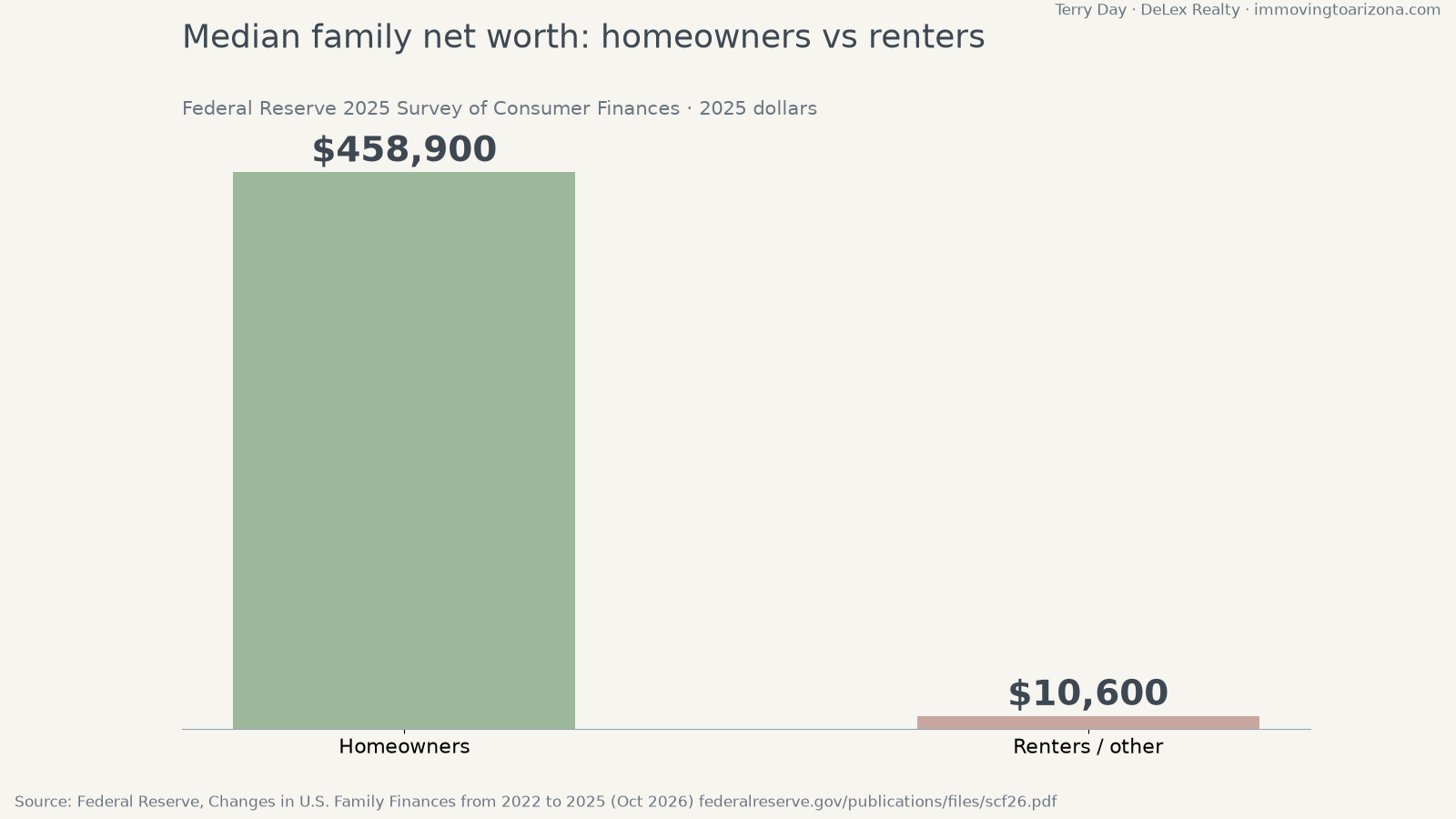
A few honest caveats. These are national medians in 2025 dollars. "Renters" in this data means renters and other non-homeowners. And the gap is a correlation, not proof that buying a home by itself creates wealth. Homeowners tend to be older and have higher incomes, among other differences. Still, the size of the gap is hard to ignore.
The same survey found:
- About 65% of families have some kind of retirement plan. Most people are already saving for retirement in some form.
- The median net housing value for homeowners was $230,000. That's home value minus mortgage debt, the equity homeowners have built in the place they live.
In other words, for a typical homeowner, the home itself is a major part of their net worth.
The housing check in Phoenix
Zillow shows the average Phoenix rent at $1,825 in October 2026. Multiply that by 12 months, and that's about $21,900 a year going toward housing. When you rent, that money pays for a place to live, which has real value, but it builds equity for the property owner, not for you.
When you own, part of each housing payment can go toward building equity in your own home. That's the idea behind "two retirements": your 401(k) is building toward your retirement, and your rent is helping build someone else's.
Alongside your 401(k), not instead of it
I want to be clear about what I'm not saying. I'm not suggesting anyone stop contributing to a retirement plan, borrow from one, or withdraw from one to buy a home. Withdrawals and loans from retirement plans have their own rules, taxes, and possible penalties. That's a conversation for your financial advisor, not your Realtor.
What I am saying is this: the housing money is already being spent. The question is whether some of it could build equity for you, alongside your retirement savings.
One path I look at: assumable FHA and VA loans
For renters thinking about buying, one path I look for is homes with assumable FHA or VA loans. An assumption lets a qualified buyer take over the seller's existing loan, subject to lender approval.
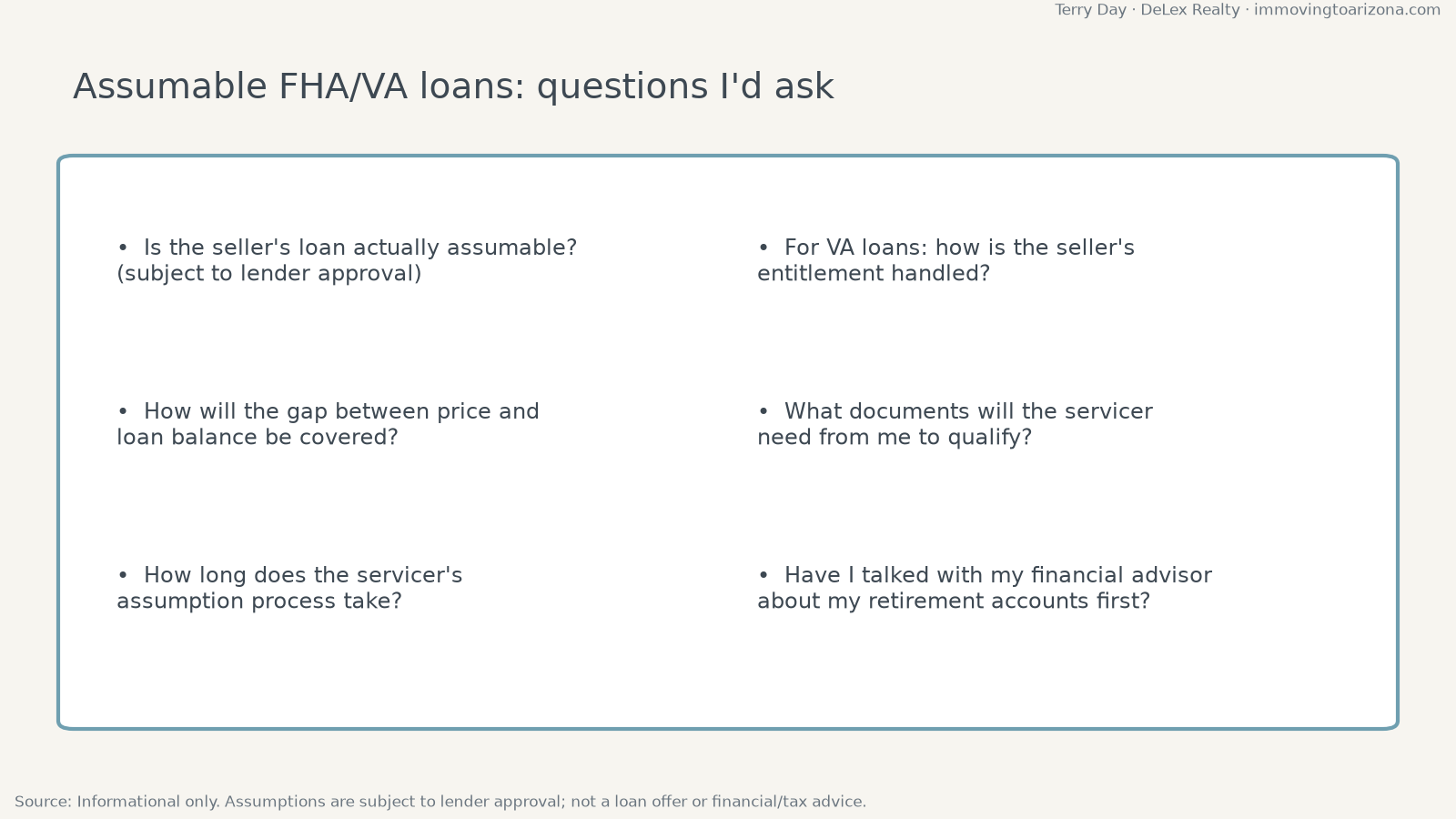
Assumptions aren't simple, and they aren't right for everyone. These are the questions I ask first:
- Is the loan actually assumable? FHA and VA loans often are, but it has to be confirmed with the loan servicer.
- How will the gap between price and loan balance be covered? The buyer generally needs to cover the difference between the purchase price and what's left on the loan.
- How long does the servicer's process take? Assumptions can take longer than a typical closing.
- On VA loans, how is the seller's entitlement handled? This matters to the seller and affects how the deal is structured.
How I'd think about next steps
If you rent in Phoenix or Scottsdale and this got you thinking, here's the order I'd suggest:
- Talk with your financial advisor about your overall picture, including retirement savings.
- Talk with a lender about what you may qualify for.
- Talk with me about what's available in the neighborhoods you're considering, including homes that may have an assumable loan.
Frequently asked questions
Do homeowners really have more net worth than renters?
According to the Federal Reserve's 2025 Survey of Consumer Finances, the median homeowner family had $458,900 in net worth, compared with $10,600 for renters and other non-homeowners. That's a national comparison and a correlation, not proof that buying alone causes the difference.
Should I use my 401(k) to buy a home?
That's a question for your financial advisor. Withdrawals and loans from retirement plans have their own rules, taxes, and possible penalties. I'm not suggesting anyone change their retirement savings.
What does "funding two retirements" mean?
It's a way of describing a paycheck that goes partly to your own retirement plan and partly to rent. Your 401(k) builds toward your retirement, while your rent helps build equity for the property owner.
What is an assumable mortgage?
An assumable mortgage lets a qualified buyer take over the seller's existing loan, subject to lender approval. FHA and VA loans are often assumable, but each one has to be confirmed with the loan servicer.
Let's talk
If you rent in Phoenix or Scottsdale and want to compare your options, call or text me at 602-483-4665.
Terry Day, Realtor, DeLex Realty. This is general information, not financial or tax advice. Talk with your financial advisor about your own situation. Data as of October 29, 2026.
Sources
- Federal Reserve, Changes in U.S. Family Finances from 2022 to 2025 (Survey of Consumer Finances): https://www.federalreserve.gov/publications/files/scf26.pdf
- Federal Reserve press release, October 9, 2026: https://www.federalreserve.gov/newsevents/pressreleases/other20261009a.htm
- Zillow, Phoenix rental market trends: https://www.zillow.com/rental-manager/market-trends/phoenix-az/